
T: +86-177-2730-8850
E: yashe2002@163.com
E: yashe2002@163.com
Third industrial estate.caobian guangfo road dali nanhai district foshan Guangdong North Road No.4


Views: 0 Author: Site Editor Publish Time: 2026-03-03 Origin: Site


When buyers ask, “Are aluminum hinges strong?”, the real question is usually more practical: Are they strong enough for my application? In hardware design, hinge strength is never determined by material alone. It depends on a combination of factors—material grade, hinge thickness, pin design, mounting method, door size, opening frequency, and the environment where the hinge will be used. That is why the answer is not simply yes or no. An Aluminium Hinge can be very strong in the right design and the right application, especially when lightweight performance, corrosion resistance, and clean appearance matter. But like any hinge material, it has limits, and understanding those limits is what helps buyers make the right decision.
From our perspective as a hinge manufacturer, aluminum hinges are often chosen because they provide an excellent balance between strength, low weight, corrosion resistance, and practical usability. They are widely used in cabinets, equipment enclosures, access panels, industrial housings, lightweight doors, and outdoor applications where reducing weight matters. In this article, we will explain how strong aluminum hinges really are, where they perform best, where they may not be the first choice, and how to judge whether an aluminium hinge is the right fit for your project.
When people talk about hinge strength, they often think only about whether the hinge can hold weight. In reality, hinge strength includes several different performance factors:
Load-bearing capacity – how much weight the hinge can support
Rigidity – how well it resists bending or twisting
Wear resistance – how well the hinge pin and knuckles hold up over repeated movement
Mounting stability – how securely the hinge stays fixed to the frame and panel
Environmental durability – how well the hinge performs over time in moisture, outdoor exposure, or industrial conditions
So, when asking whether an aluminium hinge is strong, the better question is: Is it structurally suitable for the load, frequency, and environment of the intended application?
Yes—aluminum hinges can be strong, especially when they are properly designed for the job. They are commonly used in many demanding applications because aluminum offers:
a good strength-to-weight ratio
lower overall hardware weight
natural resistance to rust
practical performance in indoor and outdoor use
easier handling for lightweight doors and panels
This means an aluminum hinge may not always match the raw load capacity of a very heavy steel hinge, but it can still deliver excellent real-world performance where moderate to high strength with lower weight is the priority.
An Aluminium Hinge is often selected because strength is only one part of the decision. In many projects, buyers also care about:
A lighter hinge can reduce total door or panel weight, making the whole assembly easier to open, close, transport, and install.
Aluminum performs well in environments where rust is a concern. This makes it useful for:
outdoor enclosures
humid areas
marine-adjacent settings
equipment housings exposed to changing weather
For many medium-duty applications, aluminum hinges provide more than enough strength while reducing unnecessary bulk.
Aluminum hinges are often used where appearance matters alongside performance, such as equipment covers, aluminum doors, cabinets, and architectural hardware.
This is one of the most common comparison questions.
In simple terms:
Steel hinges usually offer higher maximum raw load strength in very heavy-duty applications.
Aluminum hinges offer lower weight, good structural performance, and excellent corrosion resistance.
That means aluminum is not always the best choice for the heaviest industrial gate or extremely high-load metal door. But for many practical applications, an aluminium hinge is absolutely strong enough—and often more efficient because it gives you the required performance without adding extra weight.
Feature | Aluminium Hinge | Steel Hinge |
Weight | Lightweight | Heavier |
Corrosion resistance | Good | Depends on finish/material |
Strength-to-weight ratio | Very good | Strong, but heavier |
Best for | light to medium-duty, outdoor, enclosures | heavy-duty, very high load |
Handling and installation | Easier | Heavier to install |
So the better choice depends on what you need: maximum raw load, or balanced strength with lighter weight and corrosion resistance.
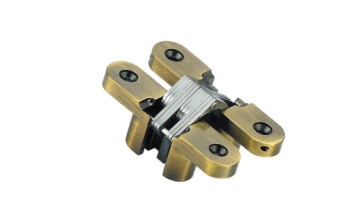
Not all aluminum hinges perform the same. A strong aluminium hinge depends on more than material alone.
Thicker hinge leaves improve rigidity and reduce flexing under load.
A larger hinge spreads force over a wider area and can support more load when mounted correctly.
The hinge pin is critical. A stronger pin and well-matched knuckle design improve wear resistance and long-term performance.
Different aluminum formulations and manufacturing methods affect final strength, consistency, and durability.
Even a strong hinge performs poorly if mounted with weak screws, thin frame material, or poor spacing.
In other words, a well-designed aluminum hinge can outperform a poorly designed heavier hinge in actual use.
From our experience, aluminium hinges are especially effective in applications where the load is meaningful, but extreme heavy-duty structural support is not the only goal.
Common applications include:
aluminum doors and frames
electrical cabinets and control boxes
equipment enclosures
access panels
lightweight machine covers
outdoor utility boxes
marine-adjacent hardware
display cabinets and industrial cabinets
These are all applications where buyers want a hinge that is durable, practical, corrosion-resistant, and easy to handle.
Although aluminum hinges are strong, there are some applications where buyers may consider other options first:
very heavy steel gates
oversized industrial doors under constant heavy load
applications with severe impact loading
situations where maximum structural mass is more important than weight savings
In these cases, heavier-duty stainless steel or steel hinge systems may be more suitable. But for many everyday industrial and commercial uses, an aluminium hinge remains an excellent balance of strength and efficiency.
One of the biggest mistakes in hinge selection is blaming the material when the real issue is load distribution.
For example:
a small hinge carrying a tall wide panel may fail regardless of material
poor hinge spacing can overload the top hinge
a continuous hinge can often outperform smaller separate hinges by distributing load more evenly
That means if an aluminum hinge “fails,” the cause may be:
wrong hinge size
poor mounting design
incorrect quantity of hinges
a load that exceeds intended use
A well-matched hinge system matters just as much as material selection.
We recommend checking these practical questions:
Weight is the first factor, but also consider how wide and tall the panel is.
Higher cycle use requires stronger pin and knuckle performance.
For outdoor or humid use, aluminum’s corrosion resistance is a major advantage.
If reducing door weight or improving handling matters, aluminum can be a smart choice.
For moderate-duty and many industrial applications, aluminum is often more than sufficient.
So, are aluminum hinges strong? Yes—when properly designed and correctly matched to the application, aluminum hinges are strong, practical, and highly reliable. They offer a very useful combination of structural performance, lighter weight, and corrosion resistance, which is why they are widely used in cabinets, enclosures, access panels, aluminum frames, and outdoor hardware. While they may not always be the first choice for the most extreme heavy-load applications, a well-made aluminium hinge is often one of the smartest choices for projects that need dependable strength without unnecessary weight.
At www.kaitegao.com, we understand that hinge selection is about real performance, not just material labels. If you are choosing an aluminium hinge for industrial, commercial, or outdoor use and want a solution that balances strength, durability, and lightweight design, you are welcome to visit www.kaitegao.com to learn more and explore suitable hinge options.
Yes. Many aluminium hinges are strong enough for lightweight to medium-duty doors, especially where low weight and corrosion resistance are important.
In maximum raw load capacity, steel is often stronger, but aluminum hinges provide excellent practical strength with the added benefits of lighter weight and rust resistance.
They are commonly used in cabinets, equipment enclosures, access panels, aluminum doors, outdoor boxes, and other applications where balanced strength and low weight are important.
Thickness, hinge size, pin design, alloy quality, and proper mounting all affect how strong an aluminium hinge performs in real use.